
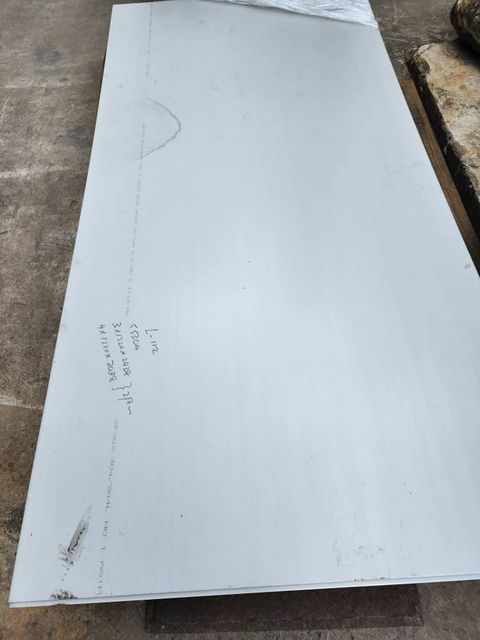
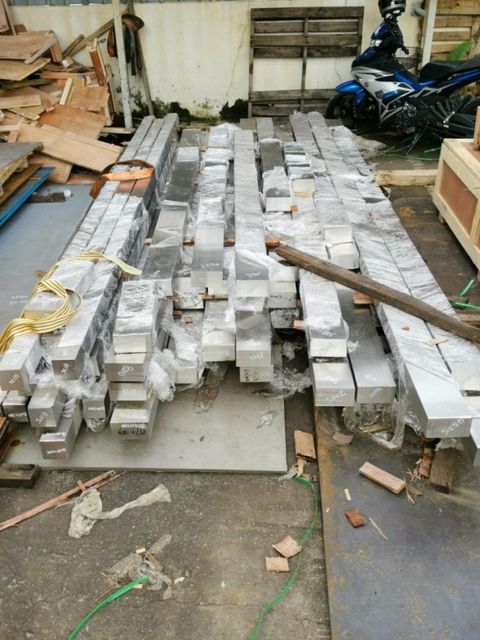
Stainless Steel 304 | SUS304 | SUS304L | Singapore Stainless Steel Supplier | UNS S30400
价格:
征求报价
Share Product:
资料
E Steel Sdn Bhd - A Leading Supplier of Stainless Steel SUS304 & SUS304L
Stainless Steel 304 / 304L (or known as SUS304 / SUS304L, UNS S30400)
Chemical Formula :
Fe, <0.08% | C, 17.5-20% | Cr, 8-11% | Ni, <2% | Mn, <1% | Si, <0.045% | P, <0.03% | S
----------
Background :
Grade 304 is the standard “18/8” stainless; it is the most versatile and most widely used stainless steel, available in a wider range of products, forms and finishes than any other. It has excellent forming and welding characteristics. The balanced austenitic structure of Grade 304 enables it to be severely deep drawn without intermediate annealing, which has made this grade dominant in the manufacture of drawn stainless parts such as sinks, hollow-ware and saucepans. For these applications, it is common to use special “304DDQ” (Deep Drawing Quality) variants. Grade 304 readily brakes or roll-formed into a variety of components for applications in the industrial, architectural, and transportation fields. Grade 304 also has outstanding welding characteristics. Post-weld annealing is not required when welding thin sections.
Grade 304L, the low carbon version of 304, does not require post-weld annealing and so is extensively used in heavy gauge components (over about 6mm). Grade 304H with its higher carbon content finds application at elevated temperatures. The austenitic structure also gives these grades excellent toughness, even down to cryogenic temperatures.
----------
Composition :
| Grade | C | Mn | Si | P | S | Cr | Mo | Ni | N | |
|---|---|---|---|---|---|---|---|---|---|---|
| 304 | min. | - | - | - | - | - | 18.0 | - | 8.0 | - |
| max. | 0.08 | 2.0 | 0.75 | 0.045 | 0.030 | 20.0 | 10.5 | 0.10 | ||
| 304L | min. | - | - | - | - | - | 18.0 | - | 8.0 | - |
| max. | 0.030 | 2.0 | 0.75 | 0.045 | 0.030 | 20.0 | 12.0 | 0.10 |
----------
Mechanical Properties :
| Grade | Tensile Strength (MPa) min | Yield Strength 0.2% Proof (MPa) min | Elongation (% in 50mm) min | Hardness (Rockwell B (HR B) max) | Hardness (Brinell (HB) max) |
|---|---|---|---|---|---|
| 304 | 515 | 205 | 40 | 92 | 201 |
| 304L | 485 | 170 | 40 | 92 | 201 |
----------
Physical Properties :
| Grade | Density (kg/m3) | Elastic Modulus (GPa) | Mean Coefficient of Thermal Expansion (μm/m/°C) | Thermal Conductivity (W/m.K) | Specific Heat 0-100°C (J/kg.K) | Electrical Resistivity (nΩ.m) | |||
|---|---|---|---|---|---|---|---|---|---|
| 0-100°C | 0-315°C | 0-538°C | at 100°C | at 500°C | |||||
| 304/L/H | 8000 | 193 | 17.2 | 17.8 | 18.4 | 16.2 | 21.5 | 500 | 720 |
----------
Corrosion Resistance :
Excellent in a wide range of atmospheric environments and many corrosive media. Subject to pitting and crevice corrosion in warm chloride environments, and to stress corrosion cracking above about 60°C. Considered resistant to potable water with up to about 200mg/L chlorides at ambient temperatures, reducing to about 150mg/L at 60°C.
----------
Heat Resistance :
Good oxidation resistance in intermittent service to 870°C and in continuous service to 925°C. Continuous use of 304 in the 425-860°C range is not recommended if subsequent aqueous corrosion resistance is important. Grade 304L is more resistant to carbide precipitation and can be heated into the above temperature range.
Grade 304H has higher strength at elevated temperatures so is often used for structural and pressure-containing applications at temperatures above about 500°C and up to about 800°C. 304H will become sensitised in the temperature range of 425-860°C; this is not a problem for high-temperature applications but will result in reduced aqueous corrosion resistance.
----------
Dual Certification :
It is common for 304 and 304L to be stocked in “Dual Certified” form, particularly in plate and pipe. These items have chemical and mechanical properties complying with both 304 and 304L specifications. Such dual certified product does not meet 304H specifications and may be unacceptable for high-temperature applications.
----------
Applications :
- Food processing equipment, particularly in beer brewing, milk processing & wine making.
- Kitchen benches, sinks, troughs, equipment and appliances
- Architectural panelling, railings & trim
- Chemical containers, including for transport
- Heat Exchangers
- Woven or welded screens for mining, quarrying & water filtration
- Threaded fasteners
- Springs
库存状态
| 供应能力 | 1000 Unit / |
| 库存状态 | 有现货 |
付款
| 付款条件 | SWIFT电汇, 电汇(T/T), 银行转帐, |
商品目录 Download